The HAICu workshop Transformative AI Meets Challenges from the Humanities took place on 2 December. Underneath, you'll find the programme and more information about the speakers and presentations.
Workshop afternoon programme
Host for the afternoon: Eveline van Rijswijk
12.45 - 13.00 walk-in (Foyer)
13.00 - 14.30 Plenary session (Aula)
- 13.00 - 13.10 Welcome by Martijn Kleppe
- 13.10 - 13.35 Eric Postma: Deep embeddings for HAICu
- 13.35 - 14.00 Tania Duarte: Communicating ethical dilemmas in co-creation projects related to AI
- 14.00 - 14.15 Enno Meijers: NDE - Building the public infrastructure for linked heritage
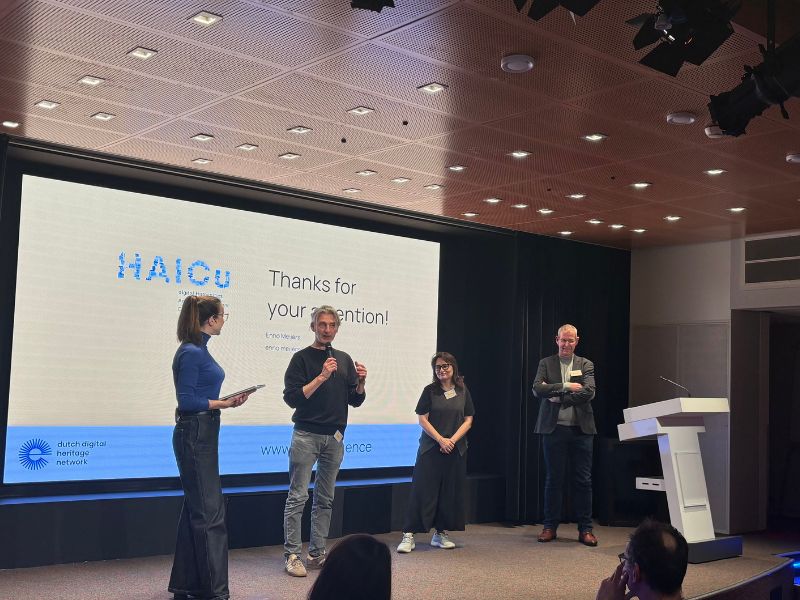
- 14.15 - 14.30 Interview of Eveline van Rijswijk with the three speakers
14:30 - 15:00 Break with coffee and thee (Foyer)
15:00 - 16:00 Short plenary intro (Aula) and breakout groups
- The Layout of Handwritten Documents as Source for Multimodal Datamining - Andreas Weber (UT), Sjors Weggeman (NHL Stenden), Ben Wolf (NHL Stenden), Klaas Dijkstra (NHL Stenden), Annemieke Romein (UT), Simon Kemper (NA) - max 24 people (room: Gruuthuse)
- Multimodal search for deep journalism? - Remco Veltkamp (UU), Marcel Broersma (UG) and Rosemarie van der Veen-Oei (KB) (room: Lancelot of KB datalab)
- Aligning humanities researchers and collection providers in data management infrastructures - Thomas Vermaut (KNAW- HuC), Jetze Touber (KNAW - DANS) and Enno Meijers (NDE, KB) (room: Aula, broad public)
- Polyvocality in heritage collections and in AI: a round table discussion on challenges and opportunities - Laura Hollink and Victor de Boer (VU) (room: Club Erasmus)
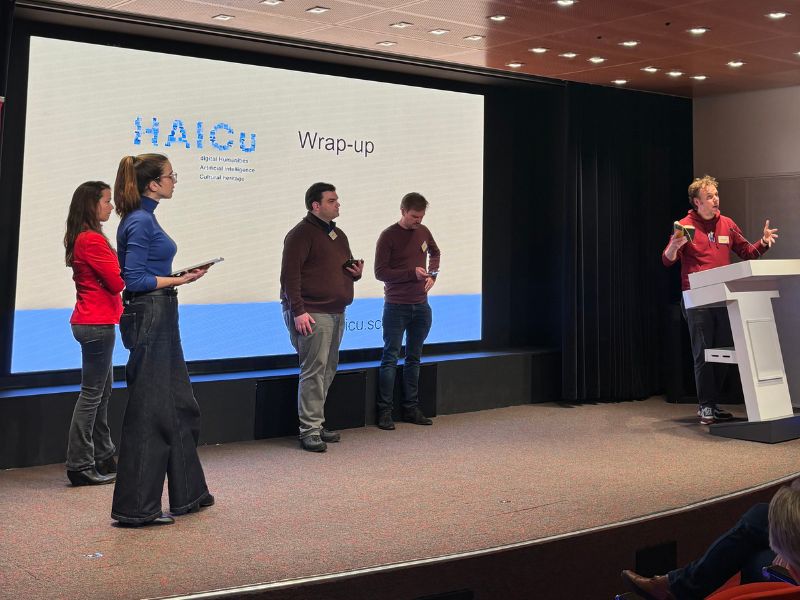
16.00 - 16.30 Wrap-up - plenary (Aula)
16.30 - 17.30 Drinks
Presentations: 13:00 - 14:30
Eric Postma
Eric Postma is a full professor in Artificial Intelligence at the Cognitive Science & AI department of Tilburg University and at the Jheronimus Academy of Data Science in 's-Hertogenbosch of Tilburg University and Eindhoven University of Technology. Eric's main research interest is pattern recognition in machines and humans. He has worked for over 30 years on AI development and evaluation, amongst others, for the attribution, authentication, and analysis of artworks. He has collaborated with the Van Gogh Museum, the MoMA, and other cultural heritage institutions. He is an unpaid advisor of the Swiss-based art authentication company Art Recognition. Within HAICu he co-leads the work package on sparse data.
Presentation: Deep embeddings for HAICu
Modern generative and deep learning algorithms provide increasingly powerful tools for accessing and studying the multimodal cultural heritage. Visual, auditory, and textual data can be represented as "deep embeddings" that enable more or less modality-independent semantic representation of data sources. The associated tools open up great opportunities for citizens and professionals who work with or in libraries, museums, and related institutes. Within HAICu, deep embeddings will be developed revolutionizing the processing, analyzing, and classifying of cultural-heritage data. In the presentation, the nature of deep embeddings and their potential will be explained in an accessible manner.
Tania Duarte
Tania is the Founder of We and AI - a non-profit focusing on critical AI literacy that runs the Better Images of AI collaboration. She is on the Founding Editorial Board for the Springer AI and Ethics Journal, a Lead for TLA Tech for Disability, in the IEEE P7015 Data and AI Literacy, Skills, and Readiness working group and a Lead for the Royal Society of Arts Responsible AI Network. Prior to this, Tania spent 30 years in consultancy, business and marketing management roles in various industries, including tech startups. Tania was one of 100 Brilliant Women in AI Ethics 2021.
Presentation: Communicating ethical dilemmas in co-creation projects related to AI
Enno Meijers
Bio: Enno Meijers is Chief Technology Officer (CTO) at the Dutch Digital Heritage Network (NDE) and advisor at the Research Department of KB|National Library of the Netherlands. Since the launch of the National Digital Heritage Strategy in 2015 he has been responsible for the technical program for improving the usability and discoverability of the Dutch heritage collections. Standardization at the source and distributed web technologies such as Linked Data and IIIF are main building blocks for the NDE-infrastructure. In the past twenty-five years Enno has been active in large scale infrastructure programs in the library and cultural heritage domain.
Presentation: NDE - Building the public infrastructure for linked heritage
The Dutch Digital Heritage Network or Netwerk Digitaal Erfgoed (NDE) is a partnership in the Netherlands that focuses on developing a system of national facilities and services for improving the visibility, usability, and sustainability of digital heritage. The network is open to all Dutch institutions and organizations in the digital heritage field. The Dutch Digital Heritage Network was established in 2015 as an initiative of the Dutch Ministry of Education, Culture and Science (OCW) and the national institutions such as the National Library of the Netherlands (KB), the Netherlands Institute for Sound and Vision (NISV), the Netherlands Cultural Heritage Agency (RCE), the Humanities Cluster of the Royal Netherlands Academy of Arts and Sciences (KNAW-HuC), the National Archives (NA) and Het Nieuwe Instituut (HNI). These national institutions take up the common responsibility for building and sustaining the network. In his contribution for the plenary session Enno will give a short overview of the NDE-program and the benefits for AI-researchers for using the NDE-services. In the breakout session Enno will present NDE’s services for finding and accessing cultural heritage information in more detail.
Break-out Groups: 15:00 - 16:00
1. The Layout of Handwritten Documents as Source for Multimodal Datamining
Despite enormous developments in the field of automated handwriting recognition (ATR), problems at the level of layout analysis still need to be addressed. This workshop explores how deep learning can be used in this area. Our use cases are challenging visual and textual structures identified in the archives of the Ministry of Colonies (1850-1900) and the archives of the Provincial States of Overijssel. Next to short presentations on the complexity of the problem space and the role of computer vision techniques to analyse clusters and predictable structures (e.g. tables, sections, marginalia) in handwritten documents, we will also discuss with the audience what our work might mean for new forms of multimodal data mining and record part linking across collections. Contributors to this workshop are affiliated with NHL Stenden, National Archives (The Hague), Collectie Overijssel (Zwolle), University of Twente and the University of Groningen.
2. Multimodal search for deep journalism
News items are often focused on a specific current event: a parliamentary debate or a certain incident, for example. While they report on the news of the day, they could also be considered as part of ongoing news stories. A single news story about refugees that have to sleep in the open air in Ter Apel is, for instance, part of a decades-long debate on immigration. Different forms of "deep" journalism are contextualizing current news events in such longer stories. In this work package we aim to understand such mechanisms and aim to develop multimodal search tools that allow journalists and others to allow longitudinal story lines using multimodal archives. This would facilitate journalistic research and reporting.
3. Aligning humanities researchers and collection providers in data management infrastructures
There is a lot happening right now concerning FAIR data access. We will explore the state of affairs from three semi-institutional perspectives: DANS from the collection-perspective, the NDE from the collection-provider perspective, and the HuC from a research perspective. Topics will be, amongst others, FAIR-implementation profiles and their (intended) scope, data-envelopes, data-sheets, etc. After an introduction of these perspectives, we want to hear about your perspective on these topics. We specifically want to include people in the conversation that are not encumbered with too much background-knowledge about these topics, but can inform us about their current practices, so as to support us in making sure we develop the infrastructure and facilities that suit your needs.
4. Polyvocality in heritage collections and in AI: a round table discussion on challenges and opportunities
Polyvocality is the idea that a cultural heritage object, event, person or concept can be looked at - and described - from multiple perspectives. Such varying perspectives can come from other cultures, other parts of the world, different periods in history, or by listening to the stories of different age groups or social groups. In this round-table discussion we will discuss the role of polyvocality in heritage collections and in AI. We invite you to share what role polyvocality plays in your research project, institute, dataset, collection, or AI application. What are the challenges that you run into? What are potential solutions?